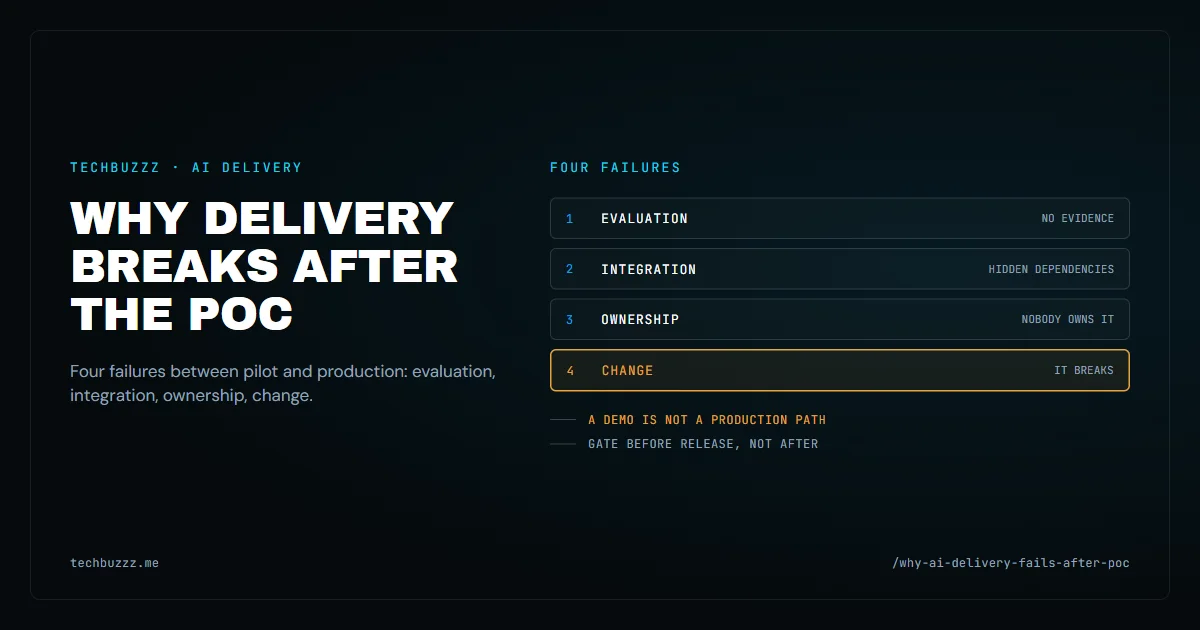
A PoC-to-production transition can be diagnosed well before launch. Below: four failure categories, the root cause of each, and the controls that remove them before release.
PoCs rarely fail because the model is incapable of producing a useful answer. They fail because the system around the model is not ready for production pressure. A proof of concept usually proves that the idea is plausible. Production proves whether the idea can survive integration, ownership, evaluation, and change over time. The same gap at the organizational level is covered in From AI Demo to Production: What Enterprise Teams Actually Need.
Engineering leaders tend to see the same pattern: the first demo works, stakeholders approve the direction, and then the project slows down as soon as real data, real users, and real operational constraints enter the picture. The failure is not mystical. It usually falls into four categories. Two come from someone else's work: evaluation debt is a term from the debt taxonomy in The Hidden Architecture of AI Failure (Wangari Global), and integration surprise paraphrases its Integration Debt category. The third, ownership vacuum, is industry jargon — IBM uses it that way, for example. The fourth, change fragility, is the only one introduced in this analysis: each category below gets its own signs, root cause, and controls.
This article is a practical guide to that transition: how to recognize each failure mode early, how to trace it to a root cause, and what to do before the PoC crosses into production.
The core issue: PoC success is not production readiness
A PoC answers a narrow question: can the system produce a useful outcome on a bounded sample under favorable conditions? Production asks a different set of questions:
- Can we measure quality consistently?
- Can we integrate with identity, permissions, logs, data, and incident response?
- Do we know who owns the system after the pilot team leaves?
- Can the system survive model drift, prompt changes, schema changes, and product changes?
If those questions are unresolved, the demo is a liability disguised as momentum.
What leaders should look for
A healthy AI project does not just show a model result. It shows:
- a defined evaluation harness,
- known acceptance thresholds [3],
- integration boundaries,
- a named operational owner,
- and a change process that is small enough to execute repeatedly.
Without those, the team will be debugging the transition instead of shipping the product.
Failure category 1: Evaluation debt
Evaluation debt is the gap between the confidence created by a PoC and the evidence required to operate the system safely. [12]
How it manifests
Typical signs include:
- Metrics are informal, anecdotal, or sample-based.
- The team evaluates only the “best” examples.
- There is no negative set, no adversarial set, and no stability check across time.
- Stakeholders argue about whether the model is “good enough” because nobody agreed on what good enough means.
- Quality appears high in a notebook or demo but drops once the prompt, data source, or traffic shape changes.
In practice, this means the team can prove a point but cannot prove a release is safe.
Root cause
Evaluation debt usually comes from treating the model as the product rather than as one component in a product system. The initial work focuses on prompt quality or model selection, while the harder work of building a repeatable assessment framework is deferred.
Common causes:
- no gold dataset,
- no rubric aligned to business risk,
- no error taxonomy,
- no baseline comparison,
- no instrumentation for regression detection.
The result is weak decision-making, not just weak measurement.
Prevention
Start evaluation before scaling the PoC. Practical controls:
- Build a small but representative test set with real edge cases.
- Define pass/fail criteria for both accuracy and failure behavior.
- Separate quality into dimensions: correctness, groundedness, latency, cost, and safety. [1]
- Track regressions as explicit release blockers.
- Re-run the same evaluation suite on every significant prompt, data, or model change.
A useful pattern is to treat evaluation like tests in software engineering. If the behavior matters, it needs a repeatable check.
Artifact: evaluation table
| Dimension | Example threshold | Why it matters |
|---|---|---|
| Correctness | 90%+ on gold set | Prevents obvious product failures |
| Groundedness | No unsupported claims in high-risk flows | Reduces hallucination risk |
| Latency | p95 under agreed SLO | Keeps user experience predictable |
| Cost | Token budget per request within plan | Prevents silent budget blowouts |
| Safety | Zero violations on blocked content set | Limits compliance exposure |
Failure category 2: Integration surprise
Integration surprise is what happens when the AI feature looks self-contained in a PoC, but production reveals hidden dependencies across identity, data access, observability, compliance, and application architecture. [12]
How it manifests
Common symptoms:
- The PoC uses a clean sample dataset, but production data is messy, incomplete, or permissioned differently.
- The model performs well, but the app cannot log prompts and outputs safely.
- Security review exposes that the feature needs access controls, data retention policies, or tenant isolation that were never designed in.
- The team discovers that the real bottleneck is not model inference but upstream data retrieval, serialization, retries, or downstream write-back.
- The feature needs more than a prompt wrapper: it needs workflow orchestration, audit trails, and fallback paths.
Root cause
The root cause is architectural isolation. The PoC is built as a thin experiment with shortcuts that bypass the actual platform constraints. That is fine for learning. It is not fine as a production pathway.
Typical gaps:
- no review of data contracts,
- no dependency map,
- no error handling for partial failures,
- no plan for multi-service observability,
- no security model for prompt/data leakage.
The team later discovers that “just add the model” means reworking half the stack.
Prevention
Do an integration-first design pass before committing to scale. Controls to adopt:
- Map all systems touched by the feature: identity, data sources, caches, queues, telemetry, and support tools.
- Define the minimal production architecture, not the demo architecture.
- Include fallback behavior for retrieval failure, model failure, and timeout failure.
- Treat prompt inputs and outputs as governed application data.
- Run a security and privacy review on the complete request path. [10]
C#/.NET 8+ example: composition root with explicit service registration
// Requires: Microsoft.Extensions.Hosting
//   dotnet add package Microsoft.Extensions.Hosting
using Microsoft.Extensions.DependencyInjection;
using Microsoft.Extensions.Hosting;

// Composition root: every dependency of the AI path is declared here,
// so it can be reviewed before the workflow reaches production.
var builder = Host.CreateApplicationBuilder(args);

builder.Services.AddSingleton<ITranscriptStore, InMemoryTranscriptStore>();
builder.Services.AddSingleton<IPromptEvaluator, PromptEvaluator>();
builder.Services.AddSingleton<IAiWorkflow, AiWorkflow>();
builder.Services.AddHostedService<AiWorkflowHostedService>();

var app = builder.Build();
await app.RunAsync();

public interface ITranscriptStore
{
    Task<string> LoadAsync(CancellationToken cancellationToken);
}

public interface IPromptEvaluator
{
    Task<EvaluationResult> EvaluateAsync(string transcript, CancellationToken cancellationToken);
}

public sealed record EvaluationResult(bool IsAccepted, string Summary);

public interface IAiWorkflow
{
    Task ExecuteAsync(CancellationToken cancellationToken);
}

public sealed class AiWorkflow : IAiWorkflow
{
    private readonly ITranscriptStore _store;
    private readonly IPromptEvaluator _evaluator;

    public AiWorkflow(ITranscriptStore store, IPromptEvaluator evaluator)
    {
        _store = store;
        _evaluator = evaluator;
    }

    public async Task ExecuteAsync(CancellationToken cancellationToken)
    {
        var transcript = await _store.LoadAsync(cancellationToken);
        var result = await _evaluator.EvaluateAsync(transcript, cancellationToken);

        if (!result.IsAccepted)
        {
            // The gate is the point: a rejected transcript stops the pipeline
            // instead of reaching production.
            throw new InvalidOperationException($"Evaluation gate failed: {result.Summary}");
        }

        Console.WriteLine($"[workflow] accepted: {result.Summary}");
    }
}

// The hosted service is what makes the registration above actually execute.
public sealed class AiWorkflowHostedService : BackgroundService
{
    private readonly IAiWorkflow _workflow;

    public AiWorkflowHostedService(IAiWorkflow workflow) => _workflow = workflow;

    protected override Task ExecuteAsync(CancellationToken stoppingToken)
        => _workflow.ExecuteAsync(stoppingToken);
}

public sealed class InMemoryTranscriptStore : ITranscriptStore
{
    public Task<string> LoadAsync(CancellationToken cancellationToken)
        => Task.FromResult("customer: how does the refund policy work?");
}

public sealed class PromptEvaluator : IPromptEvaluator
{
    public Task<EvaluationResult> EvaluateAsync(string transcript, CancellationToken cancellationToken)
        => Task.FromResult(new EvaluationResult(IsAccepted: true, Summary: "answer is grounded in the policy document"));
}
The example shows only one thing: the dependencies are declared explicitly, so they can be reviewed before a production path exists. [8]
Failure category 3: Ownership vacuum
Ownership vacuum happens when everyone is enthusiastic during the PoC, but nobody is accountable for the system after launch.
How it manifests
Signs include:
- The pilot team is a temporary cross-functional group with no long-term owner.
- Product wants the feature, research built the demo, and platform is expected to operate it, but none of them has full authority.
- Incident response is unclear.
- When quality degrades, people ask who should fix the prompt, the model, the data, or the product workflow.
- The system survives in a “demo always on” state but never becomes a supported service.
Root cause
Ownership vacuum is a management failure, not a technical one. It appears when responsibility is split across functions without a single operating model.
Common structural causes:
- success criteria belong to one team, operations to another,
- delivery is funded as a project, but run as a product,
- no service owner is named,
- no on-call or escalation path exists,
- no budget line exists for evaluation and maintenance.
If nobody owns the system life cycle, the PoC becomes a permanent exception.
Prevention
Assign ownership before production. Minimum operating model:
- One product owner with business accountability.
- One engineering owner with technical accountability.
- One operational owner with support and incident accountability.
- A defined RACI for model updates, prompt updates, data changes, and rollback decisions.
- A budget for monitoring, evaluation, and retraining or prompt revision.
Go/no-go checklist for ownership
- Named service owner approved by product and engineering.
- On-call or escalation path documented. [4]
- Runbook exists for model, prompt, and data failures.
- Release authority defined for changes affecting quality or safety.
- Support and incident channels tested before launch.
Failure category 4: Change fragility
Change fragility is the tendency for a system to break whenever the environment changes: a new model version, a different prompt, a schema update, a new policy, or a shift in user behavior.
How it manifests
You usually see:
- a small prompt change unexpectedly alters output shape,
- a model upgrade improves one metric while damaging another,
- a retrieval index refresh changes answer distribution,
- a schema migration breaks downstream parsing,
- a policy update changes what the assistant is allowed to say,
- one team’s “minor” improvement causes a production incident elsewhere.
Root cause
The cause is usually tight coupling and weak release discipline. The PoC may have been built fast with implicit assumptions, but those assumptions were never turned into contract tests, versioning, or rollout controls.
Typical missing pieces:
- input/output schema contracts,
- versioned prompts and model configs,
- canary releases,
- rollback plans,
- regression tests for critical tasks,
- drift monitoring.
Prevention
Build for controlled change, not static perfection. Use these safeguards:
- Version prompts, datasets, and model configurations. [7]
- Add contract tests for critical output formats. [6]
- Canary every meaningful change. [5]
- Require rollback criteria before launch.
- Monitor drift in both quality and cost.
If a small change cannot be isolated, the system is too fragile for production.
Self-check against the four categories
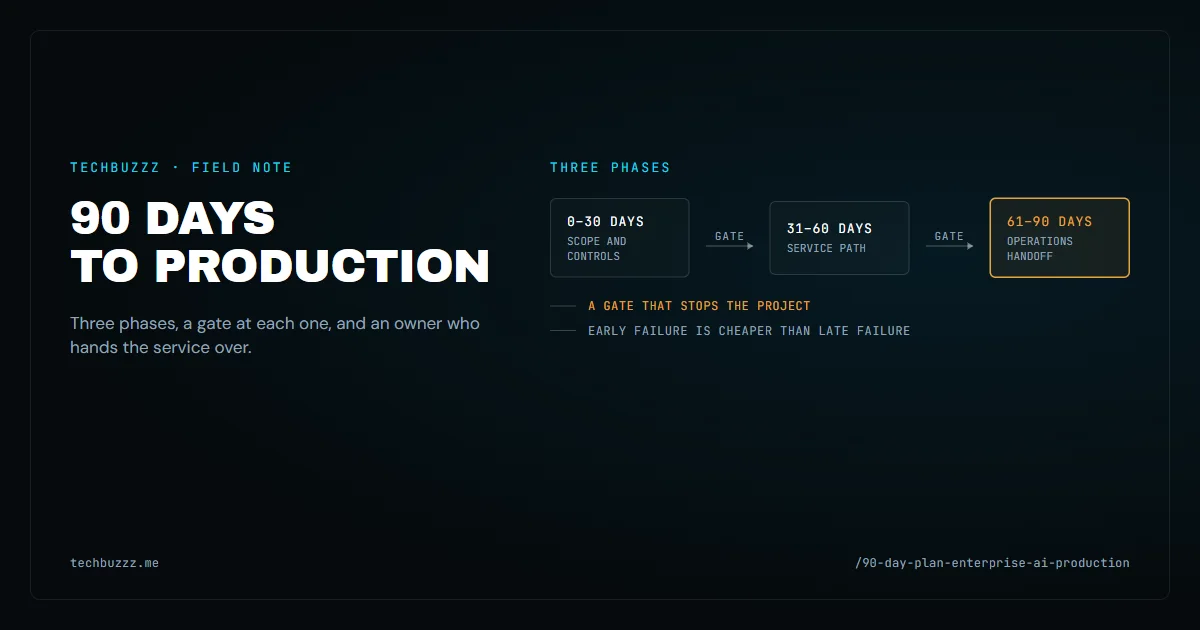
The checklist below answers one question: which category are we failing in. It does not answer the next one — what to fix first, and in what order. The sequence of work, the transition criteria between phases, and the owner roles are covered in A 90-Day Plan for Taking an Enterprise AI Initiative to Production.
Evaluation debt
- A gold set exists with representative normal and edge cases.
- The quality rubric is approved by product, engineering, and risk stakeholders.
- Baseline latency, cost, and failure rate are measured on realistic traffic.
- Data sources and access boundaries are documented.
Integration surprise
- Authentication and authorization are enforced on the real request path.
- Logging, tracing, and redaction are active in lower environments.
- Fallback behavior exists for model timeout, retrieval failure, and empty result sets.
- Contract tests cover the top user journeys and critical output shapes.
Ownership vacuum
- A named service owner is approved by product and engineering.
- The support workflow and escalation path are documented and reviewed.
- Blocking issues are listed with explicit owners and dates.
- Ownership and budget for ongoing evaluation are formally assigned.
Change fragility
- Versioning exists for prompts, models, and retrieval configuration.
- A canary or staged rollout process is in place for major changes.
- Regression detection is wired into release approval.
- A monthly review cadence exists for incidents, drift, and cost variance.
A practical decision rule
A PoC should not move to production because it impressed people in a meeting. It should move because the team can show the following:
- the system is measurable,
- the system is integrated,
- the system is owned,
- and the system can absorb change without surprise.
If one of those is missing, the next phase is not launch. It is reduction of risk.
Conclusion — four failures surface before release
Failures after the PoC rarely mean the model was not capable enough. More often they are failures of engineering discipline around evaluation, integration, ownership, and change control. That is good news, because those problems are addressable.
Engineering leaders do not need a perfect model to ship responsibly. They need a production path with explicit gates. When teams build the evaluation harness, map the integration surface, assign ownership, and harden the change process, the PoC stops being a slide and starts becoming a service.
One way to check this on your own system is to take the last change that reached production and see whether the team’s artifacts can explain what changed and why it was safe. If they cannot, the failure sits in one of the four categories above, and the place to start is usually the one without an owner.
If your team is moving from a demo to deployment, the checklist above works best as the first production gate rather than the last one. The sequence of work and the owner roles per phase are in A 90-Day Plan for Taking an Enterprise AI Initiative to Production.
Sources
- A Survey on Evaluation of Large Language Models (Chang et al.) — A survey of LLM evaluation methods, from automatic metrics to human annotation
- Judging LLM-as-a-Judge with MT-Bench and Chatbot Arena (Zheng et al.) — LLM-as-a-judge: where it agrees with human preference, and where it does not
- Service Level Objectives — Google SRE Book — Formalizing the service level a release decision can rely on
- Being on Call — Google SRE Book — What ownership after the handoff actually means
- Canarying Releases — Google SRE Workbook — Rolling out gradually to limit the blast radius of a change
- Contract Test — Martin Fowler — Contract tests: checking that a test double still matches the contract of the external service
- The Twelve-Factor App — Separating config from code, dependencies from the environment — the baseline of a service path
- Dependency injection guidelines — Microsoft Learn — Registering dependencies in the composition root and the lifetime of dependencies
- Generic Host — Microsoft Learn — The host the composition root sample runs inside
- OWASP Top 10 for LLM Applications — Application-level risks: prompt injection, data leakage, excessive agency
- Model Cards for Model Reporting — Google Research — Documenting a model and its limits for the people who decide whether to use it
- The Hidden Architecture of AI Failure — Wangari Global — The debt taxonomy: source of the term evaluation debt and of the Integration Debt category behind integration surprise
- The Phantom ROI in AI — IBM — An industry term: how IBM uses the ownership vacuum